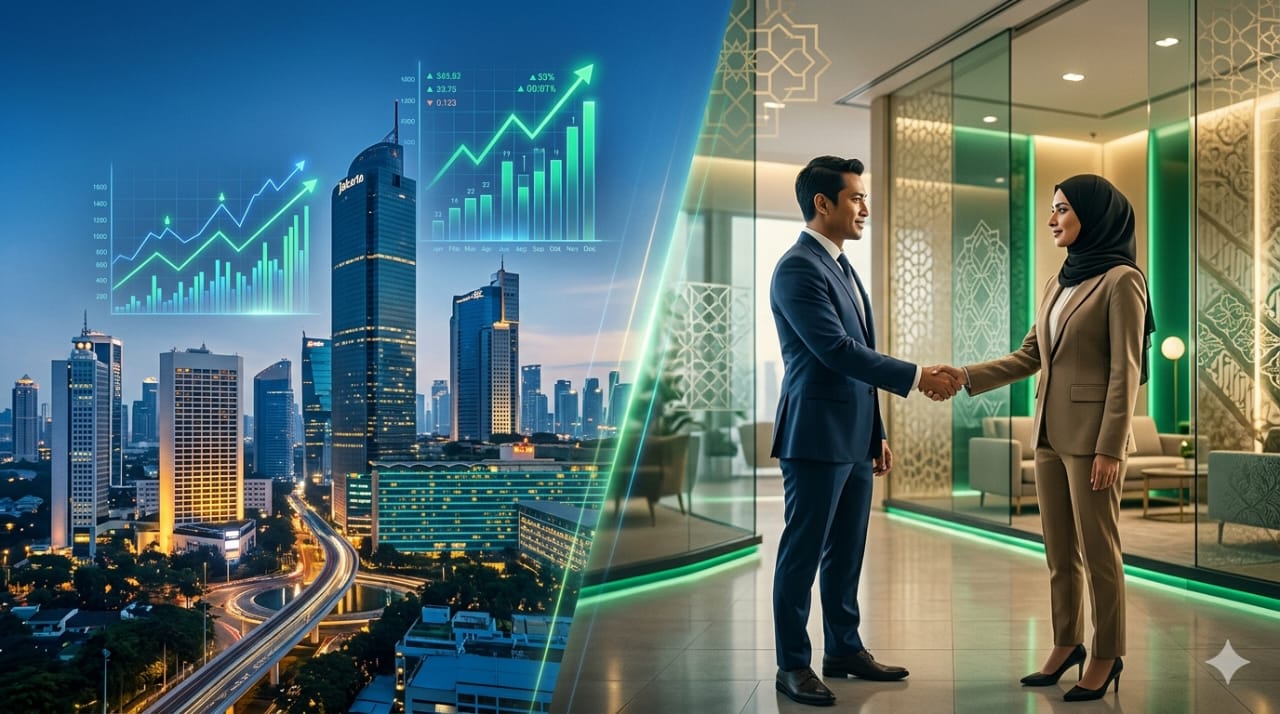

Recently, there has been a notable surge in debates surrounding the future of humanity in light of accelerating technological leaps. Some futuristic readings, such as those presented by leading platforms like the “Grammatopia” channel, tend to paint dramatic scenarios regarding artificial intelligence reaching the point of “Singularity” and fully simulating human consciousness. However, away from the fears of extinction or the total dissolution of human effort into the machine, practical reality imposes a more balanced vision; one that views AI as a positive driver for growth and a strategic partner capable of reshaping the business sector, provided there is wise human leadership and strict ethical guidelines.
Intelligent Penetration into the World of Business and Projects
AI is no longer just a technological luxury; it has become the backbone of the modern economy. Today, various types of businesses rely fundamentally—directly or indirectly, fully or partially—on intelligent systems. This influence clearly extends to critical sectors such as medicine, advanced analytics, and one of the most vital pillars of organizational success: Project Management.
In contemporary project management environments, AI has sparked a true revolution in the planning and scheduling phase. Intelligent tools are now capable of:
Estimating costs and budgets (Cost Estimation) with extreme accuracy.
Allocating tasks and analyzing risks based on massive and complex data.
Saving time and effort in computational and routine operations, granting organizations a competitive advantage and superior speed in execution.
Machine Limitations and the Centrality of the Human Factor: The Golden Equation
Despite this tremendous development and the global proliferation of intelligent applications made available to the general public, a false impression sometimes prevails that AI can do everything on our behalf. This premise lacks accuracy, and the reason lies in the golden technical rule: “Garbage in, garbage out” (The quality of outputs depends entirely on the quality of inputs). Artificial intelligence remains a highly sophisticated assistant tool, and it cannot be fully relied upon at present to steer the ship alone.
The success of any project or business does not stop at rigid numerical calculations; rather, it hinges on core elements that humans alone hold the keys to:
Continuous Evaluation and Complex Problem Solving: Emerging crises in projects require flexibility and human intuition that go beyond fixed algorithms.
Effective Communication and the Psychology of Work: Managing teams, understanding employee emotions, and negotiating with stakeholders are emotional and social leadership skills that a machine cannot truly replicate.
From this perspective, the concept of “Shared Leadership” emerges as the best strategy for the future; where intelligent systems provide accurate information and analytical data, while the human takes charge of leadership, direction, and strategic decision-making.
The Duality of Risks: What Threatens This Future?
While we look with positivity and optimism at the solutions and facilities provided by artificial intelligence, we cannot ignore the dark side and existential warnings raised by scientific circles. The real risks we face today fall into two basic categories:
First: The Risk of Underestimation and Misuse: This is represented by the rush toward total and blind reliance on these tools without auditing their outputs, which may lead to making decisions based on misleading data or incorrect inputs, alongside the risk of atrophy of human and analytical skills due to cognitive laziness.
Second: The Risk of the Absence of Legal and Ethical Frameworks: This is the greatest risk threatening the human future. The accelerating development in brain-network interfacing technologies, digital twins, and others is proceeding in an environment that lacks firm international legislation regulating this new industry. If societies and governments do not act seriously and immediately to draft laws that protect human identity, privacy, and social justice, we may face a future where humanity is unable to control its most intelligent tool.
Conclusion
Artificial intelligence opens doors to unprecedented opportunities in human history; it streamlines business, enhances productivity, and provides us with highly important scientific and medical insights. However, keeping this development on its positive track depends on our awareness. We must always remember that technology was created to be a servant and an assistant to humans, not a substitute for them. Our future will not be determined by the power of algorithms alone, but rather by the ethical wisdom and laws we establish to guide this power toward building a more elevated and secure human civilization