
In the fast-paced world of business, many entrepreneurs fall into the trap of impulsive enthusiasm, leaping directly into the implementation phase without pausing to evaluate the ground they stand on. While starting a project without prior study is technically “possible,” it is akin to sailing in stormy seas without a compass or a map; you might reach your destination by chance, but the probability of sinking remains high.
Moving from an “idea” to a “tangible reality” requires a scientific methodology that ensures the vision is transformed into concrete results. This methodology consists of essential, interconnected steps.
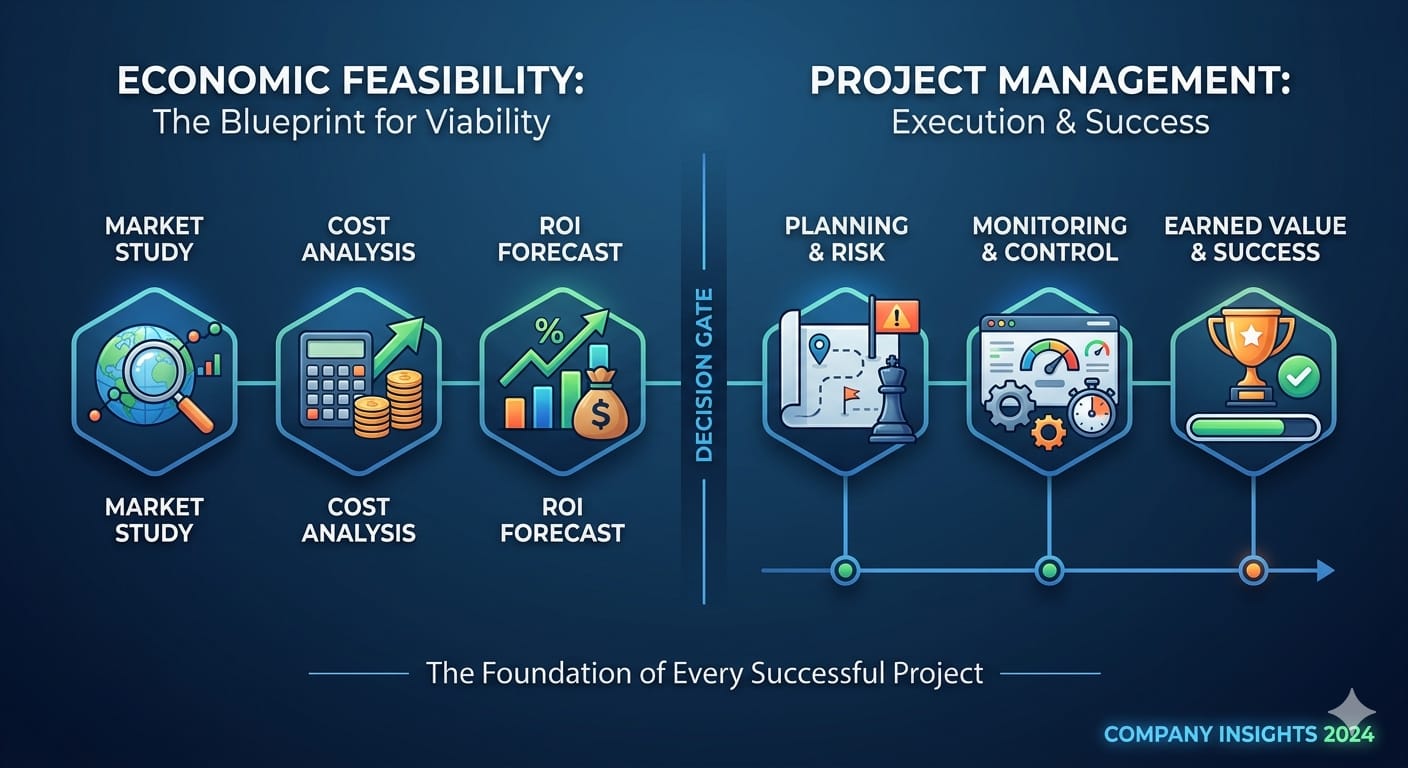
1. Economic Feasibility: The First Reality Check
Economic feasibility is the first line of defense against failure. It is not merely about numbers; it is a “truth test” that answers a fundamental question: Is this project sustainable?
Through feasibility studies, we can estimate market size, demand, and projected returns. These studies provide the initial indicators of whether a project will succeed or falter before a single penny is spent on execution.
2. Beyond Feasibility: Detailed Project Study
Economic feasibility alone is not enough. Once the viability of the idea is confirmed, we move to a detailed study. In this phase, the project is broken down into precise components:
Initial Costs: Determining the required capital accurately.
Resources: Identifying human capital, technologies, and raw materials.
Management Structure: Mapping out workflows and responsibilities.
Risk Assessment: Predicting potential obstacles before they occur.
3. Planning and Implementation: Engineering the Work
After fulfilling the study requirements, the project planning process begins, which establishes the roadmap. Here, milestones and timeframes are defined. When moving to execution, adherence to the plan becomes the benchmark for measuring work efficiency.
4. Monitoring and Review: The Safety Valve
The most common mistake is a “rigid plan.” A successful project requires continuous monitoring and review. There must be periodic audits:
Plan vs. Actual: What is the actual progress compared to the plan?
Cost Control: Are we within the allocated budget?
Earned Value: Measuring what the project has actually achieved versus the resources consumed.
Smart monitoring allows for rapid intervention to implement corrective actions before minor deviations turn into structural crises.
Can We Skip the Experts and Studies?
Some argue, “Why waste time and money on studies? Let’s just start.” The reality is that you are paying for these studies regardless—either at the beginning (as a preventive investment), or later (as losses resulting from mismanagement).
Ignoring project management and relying on randomness raises the risk profile to dangerous levels. A project might stop due to a reason that could have been identified in the initial risk assessment, or the budget might evaporate due to inaccurate assumptions that were never tested.
Conclusion: The Principle is Universal
While the nature of projects may vary—whether technical, industrial, or service-based—the management principle remains constant: Planning reduces risk, and monitoring ensures continuity.
Success in the business world is not a stroke of luck; it is a natural result of conscious study, meticulous planning, vigilant monitoring, and timely, intelligent intervention. Investing in the “preparation period” is the true guarantee of bringing a project to its natural, successful conclusion.